Hand out Claude Code licences willy-nilly, wait six months, and nobody knows what half the PRs do.
I've seen this enough times now to call it a pattern. Engineering gets the benefits of AI first, velocity goes up and the board slide writes itself. Then the review queue backs up, code quality falls off a cliff, and soon nobody on the team can explain the codebase from memory.
The bottleneck has moved to review and understanding, and an off-the-shelf software factory won't move it back. Worse, it takes your hands off the wheel, and with them the skill your engineers will need most.
Building is the fun part
And I'm as guilty as anyone. Give any rational human a tool that makes building things ten times faster and they'll build more, and plan and verify less. Then measure them on output rather than the value they add, and you've built a culture that produces PRs.
The less people look at code, the less reason they have to get upset about tech debt. So it piles up unnoticed, a problem for future you, until the agents can't cope with it either.
Max flow = min cut
Put simply, a system only moves as fast as its narrowest point.
Model your delivery pipeline as a flow network and that narrowest point is the min cut. That is, the set of edges with the smallest total capacity that would cut start off from finish. The most you can push through the whole network (the max flow) is exactly that capacity. That's the max-flow min-cut theorem, and I won't go into the weeds of proving it.
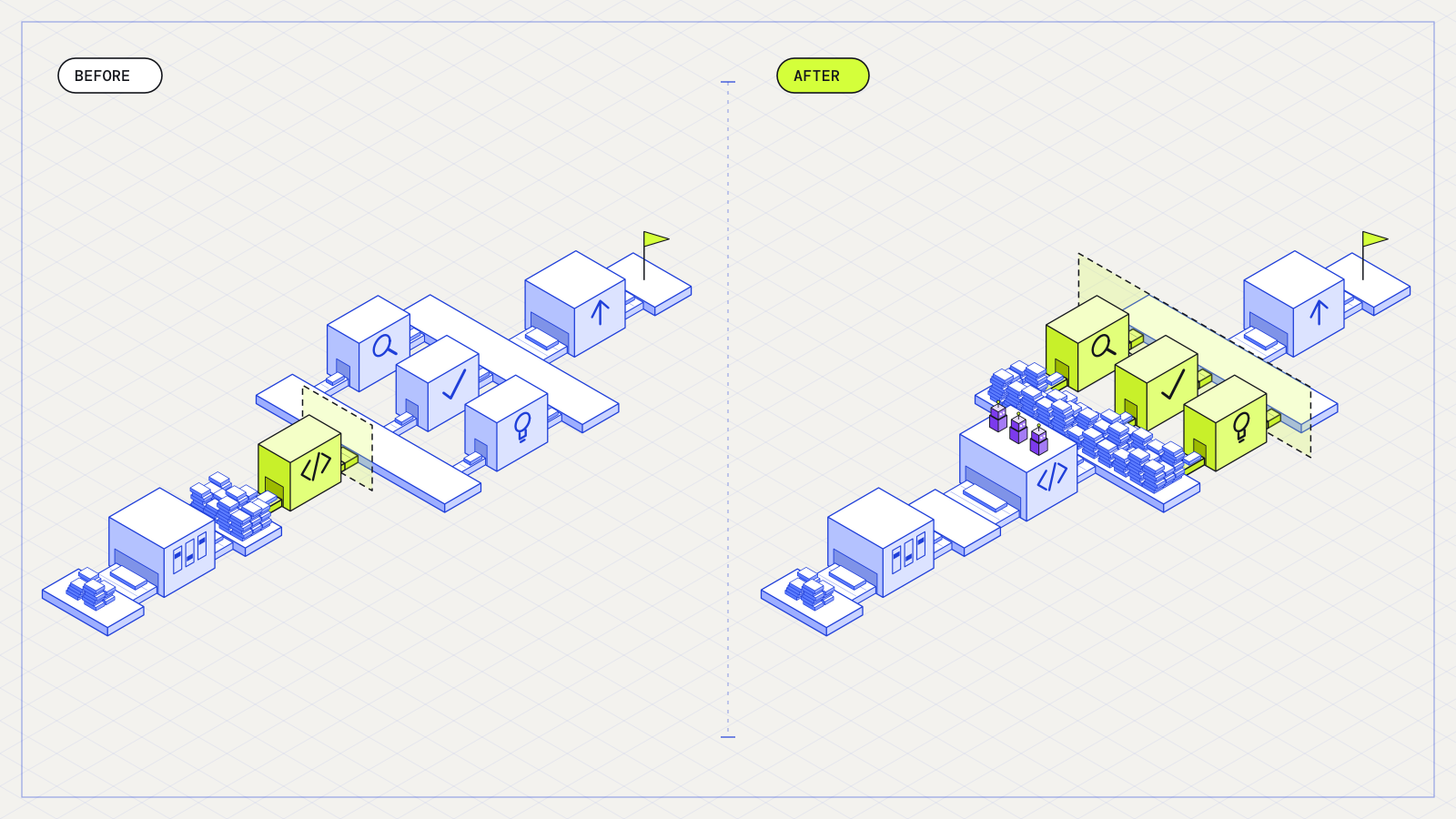
Widen any edge that isn't on the cut and throughput doesn't budge. You've just piled more work up in front of the same constraint.
Handing out coding agents widens the "write code" edge. Job done, right? No. The cut is now review, verification and understanding, and more code generation won't touch it.
My new favourite anti-pattern: meat-proxying
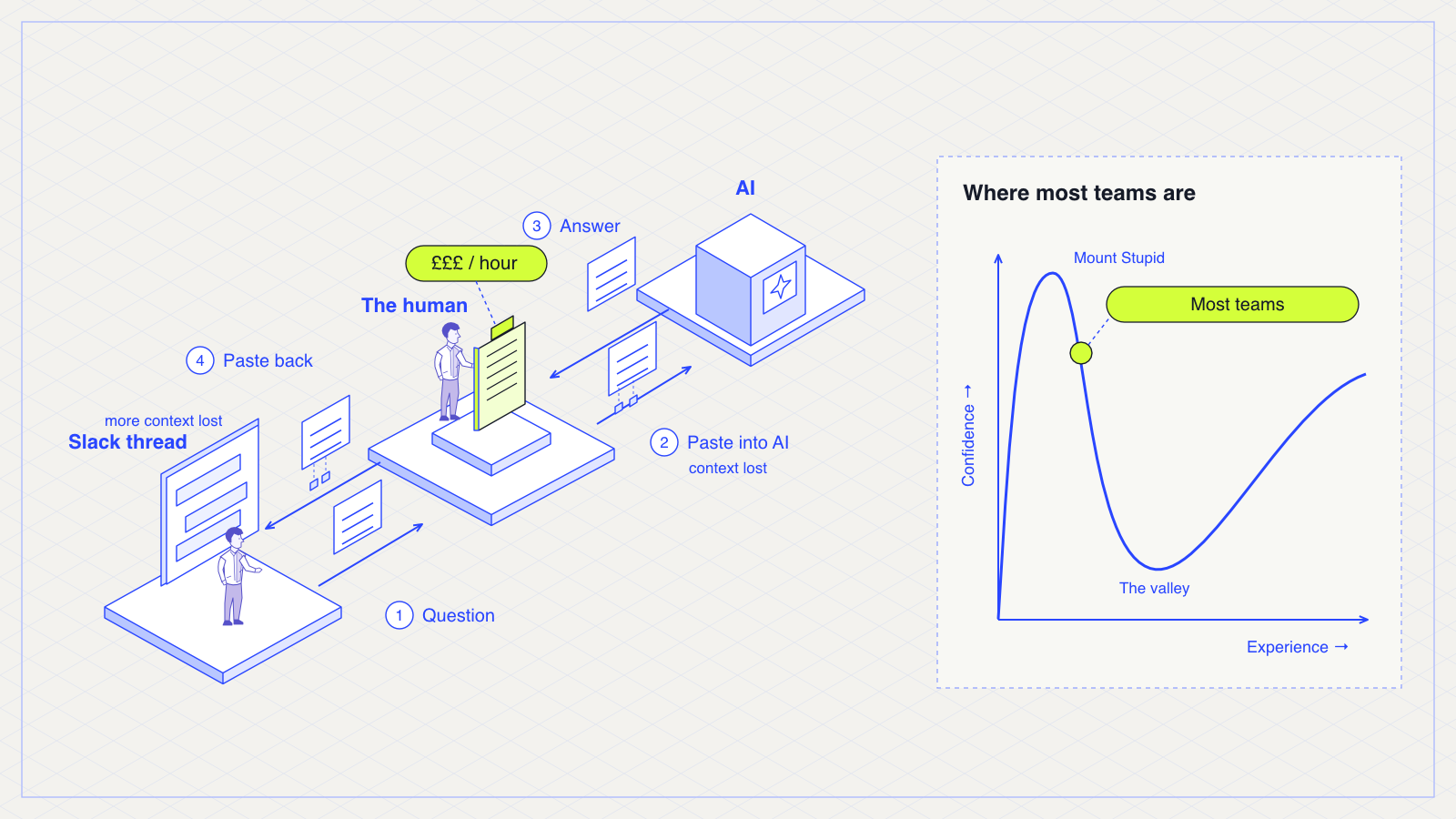
A question lands in Slack. Someone pastes it into Claude, then pastes the answer back. The human in the middle is now a very expensive clipboard. Context gets lost at every stage, and nobody in the chain actually understands the problem.
Most teams I talk to are here, and I've been here myself. It's what an understanding bottleneck looks like from the inside.
The wrong fix
The instinctive response is "we can't keep up, so let's automate the rest of the SDLC too".
Most teams are on cruise control today. The agent handles the code on the clear, straight bits of motorway, and everything around it (planning, review, verification) still runs the old way. Being AI-native means the AI takes the first stab at the whole journey, and you steer when it heads the wrong way.
A software factory sells you a robotaxi instead. It does drive itself, but you're a passenger. It only goes where the vendor has mapped, and it isn't your car. It's another inflexible tool to maintain, and it decides what "good" looks like for you.
Every factory will tell you it's flexible. It can't be, not completely. The moment something is a product it has to serve every customer at once, and the roadmap belongs to the vendor. You get the options they chose to expose, and nothing else.
And you already know what good looks like. It's a green CI check you can trust to have your back covered. That was true before AI, and it's still true now.
Build the capability
You don't need a software factory. You need the capability to build what works for you.
Capability is your team understanding its own pipeline well enough to change it, adding a check when something slips through and removing one when it's just noise. Build that bit by bit, from known primitives, and it grows with you.
That capability is also where engineering is heading. Building and maintaining agentic workflows is going to be a core engineering skill, the same way CI/CD and infrastructure as code became one. A factory doesn't just own your pipeline, it owns the know-how to build one.
Hide that from your engineers and you're doing them a disservice. They never learn to build or tune a workflow, only to ride in someone else's. They're passengers again, and that's just meat-proxying with a nicer seat.
"Agentic readiness" is a gate you don't need
There's loads of talk about agentic readiness and whether your estate is "prepared" to have AI wreak havoc on it.
It's far too prohibitive. No estate is ever finished, so you'd be waiting for every traffic light in the country to go green before anyone drives. Start today, with the codebase you've got, and build up from there.
PRs shouldn't be a surprise
Back to that cut. Review is only half of it. You can't review your way into understanding a change you never asked for.
So move understanding upstream. Before anyone builds anything, agree on the problem, the approach and what "done" looks like. It's the planning everyone skips because building is more fun. Let the agent draft the spec, have the people who'll own the code pick holes in it, and don't build anything until they're happy.
Then the PR is just the receipt. I want to open one and think "yep, that's what we discussed". If a PR surprises me, something's gone wrong before the diff.
The spec also gives verification something to check against. "Does this look OK?" is vibes-based and nondeterministic. "Does this do what we agreed?" is actually measurable.
The risk ladder
Every PR gets a deterministic score on a risk ladder, and that score decides the review panel. Deterministic matters. The model doesn't get to "vibe" its way into deciding how much scrutiny a change deserves.
Code graphs give you blast radius - what does this change touch, and what touches it? Add real usage data and you can weight each change by actual user impact. A one-line change on the checkout path isn't the same as refactoring an admin page three people use.
So there's no one workflow to rule them all. Some changes need a fleet of reviewers, some just need a spot check from Haiku or Luna.
The thresholds aren't fixed either. You keep tuning them based on what actually works. That's only possible because they're yours. A vendor tunes its thresholds for its average customer, and nobody's checkout path is average.
It works like the levels of self-driving: you earn autonomy one road at a time. On the quiet, well-mapped roads (that admin page again), let it drive. On the checkout path, hands back on the wheel. The risk ladder tells you which road you're on, and as trust builds, more of your roads go self-driving.
I don't want to review PRs anymore. I want to make sure the car is headed in the right direction.
Where to start
It depends where it hurts. Start there, and iterate as requirements surface. Focus on the quick wins, because they build trust and show you where it hurts next, then work up to the harder problems. Tooling is an implementation detail.
That's how we're doing it at CreateFuture, with Fleet. It isn't SaaS. We're a consultancy, so Fleet is a service: a set of engineering primitives across Define, Build and Verify that run on your approved infrastructure, working with whichever model and cloud you already use. Every workflow is built with you, around how you already work. Happy with your ticket refinement process? Keep it, and just use Build and Verify.
A factory asks you to adopt its process. Fleet lets you adopt one piece at a time, and we build it alongside your engineers, so the skill stays with your team after we've gone.
AI is the easy part. The culture is the thing we're enabling.
Want to see what Fleet could do for your engineering teams? We’d be happy to show you. Find out more about how we help teams build with AI agents here.
You might also be interested in our other accelerators, including Atlas, which reads your estate to reveal risks and opportunities, and Compass, which connects that data to your business constraints so you can make better decisions. Find out more about them here.
Meet the author
Owen Lacey is a Principal Engineer at CreateFuture. With over a decade in software consultancy, including more than eight years at Audacia, and certifications from both Anthropic and OpenAI, he helps organisations architect and deliver AI-powered products across cloud, data and modern web platforms.

Industry Insights
Explore the latest thinking from our industry and tech experts.

Your discovery phase is already out of date
What is AI native?

You’ve got the data, but you don’t have the answers