
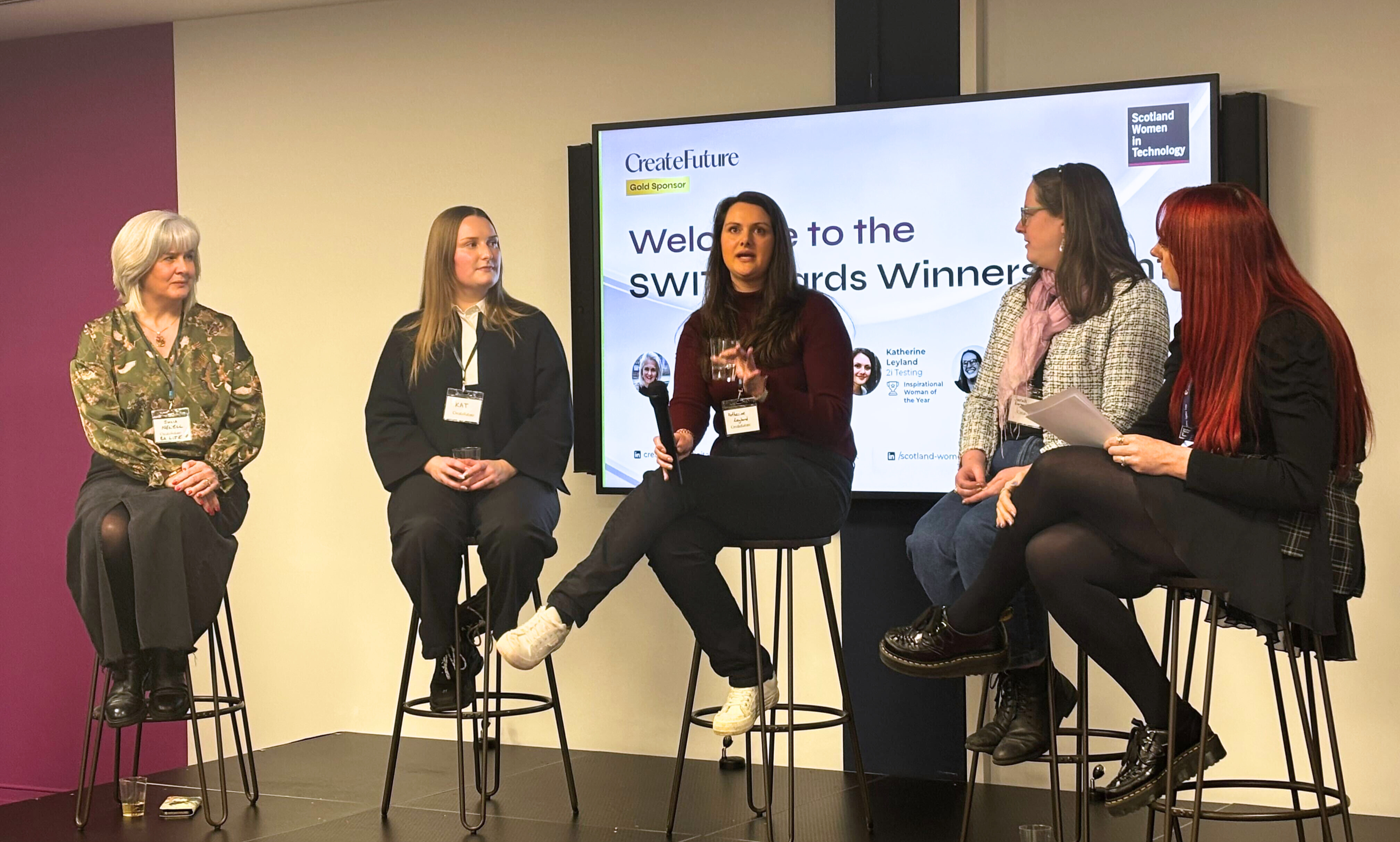
Last week at Waterloo Place, one sentence stopped the room: "You aren't blowing your own trumpet when it’s a fact." It set the tone for an evening with the 2025 Scotland Women in Technology (SWiT) award winners. The evening moved past performative confidence to focus on survival with integrity.
In partnership with SWiT, we welcomed four winners to the stage to discuss what it akes to lead in the Scottish tech ecosystem. Facilitating the conversation meant hearing first-hand about the grit, accountability and quiet determination behind their journeys.
Why visibility is essential in Scottish tech
The Scottish digital technology sector is growing fast, contributing £6.87 billion in gross value added (GVA) to the economy. It’s ambitious, well-funded and increasingly visible on the global stage.
Women still make up just 23% of the digital tech workforce in Scotland. That imbalance shapes the experience of women in leadership in ways that aren’t always obvious but are always present. When you are in the minority, pressure shows up differently. The bar can feel higher. The margin for error can feel smaller. The instinct to overperform and under-claim throughout your career becomes stronger.
During our discussion, we explored how the pressure to be perfect often stops women from claiming their space. Imposter syndrome is very real, but as our speakers discussed, results in tech are data points. To own your success is not ego, it’s crucial for progressing and leading in your tech career.
How to lead as a woman in Scottish tech: 4 practical shifts
1. Lead with objective data
The room went quiet when Julia Newell (Director at BA Life and "Unsung Hero" winner) challenged the habit of downplaying results. Her stance was clear: "You aren't blowing your own trumpet when it's a fact."
For many, this was a necessary shift in perspective. We often treat hard-won achievements as flukes. In a technical environment, results are data points. Whether you are a founder or an engineer, owning your impact is a leadership requirement. When internal confidence fails, you need a "Linda" (referencing mentor and peer Linda Parker). This is the person in your corner who hypes you, grounds you and reminds you of your worth when imposter syndrome tries to take the wheel.
2. Build confidence through action
A recurring theme was that confidence is not a prerequisite for action. It is a result of it. The panel advocated for "doing it scared."
Katarina Svistseva (Founder of The Data Gals and "Mentor of the Year") spoke about the "pinch me" moment of being on stage while navigating the weight of imposter syndrome.
Growth lives on the other side of that discomfort. Whether it is Julia Newell’s five charity skydives or Katherine Leyland’s (2i, "Inspirational Woman of the Year") career pivot from teaching into engineering, action is the only fix for fear.
3. Use practical vulnerability
"Doing it scared" does not mean constant hustle. Our panellists highlighted that sustainable leadership requires boundaries and a more human approach. We often see "transformation" used as a corporate label for working harder, but true transformation is about working differently and finding strength in vulnerability.
4. Build your tribe
We finished the evening with a reminder of something that felt both obvious and urgent: careers do not move forward alone. Women who have mentors and sponsors are consistently shown to progress further than those without that kind of structured support. That isn’t a neat slogan. It reflects how opportunity works. When someone is willing to advocate for you, challenge you and name your potential out loud, the path becomes clearer.
The Scottish tech world is richer and braver when we gather to name the fear, the exhaustion and the impossible choices, and then decide to keep going anyway. What stayed with me was not a sense that individuals need to “fix” themselves to succeed, but that we need to be more deliberate about the systems around them. Mentorship, visibility and honest backing are not soft extras. They are part of the infrastructure that makes collective success possible.
Practise what you preach
What I didn’t expect was how quickly the message would come back to me.
After an evening spent encouraging others to own their impact, I found myself instinctively downplaying kind words about my own facilitation. The compliments were generous. My reaction was to brush them off. Standard reflex. It was a small but useful reminder that the habits we are trying to unlearn run deep. Even when you are repeating the message, “You aren’t blowing your own trumpet when it’s true,” it can still feel easier to deflect than to accept.
That was the thread running through the night. Leadership is not about bravado. It is about being clear on your contribution and allowing it to be seen. If Scotland’s tech sector wants to grow well, it needs more leaders who are comfortable standing behind their work and helping others do the same.
Sometimes the work starts with taking your own advice.
FAQs
Meet the author
Mari Currie is a Principal Delivery Manager at CreateFuture. She works with organisations delivering complex digital products, helping teams align around outcomes and creating the conditions for sustainable, effective delivery.
.png?width=800&height=800&name=Untitled%20design%20(4).png)
Industry Insights
Explore the latest thinking from our industry and tech experts.

AI in UK wealth and pensions: 5 themes reshaping customer experience

Why do AI experiments fail and how do you scale AI-native delivery?
Empowering Women in Tech: Key Takeaways from CreateFuture's Recent Panel Discussion