

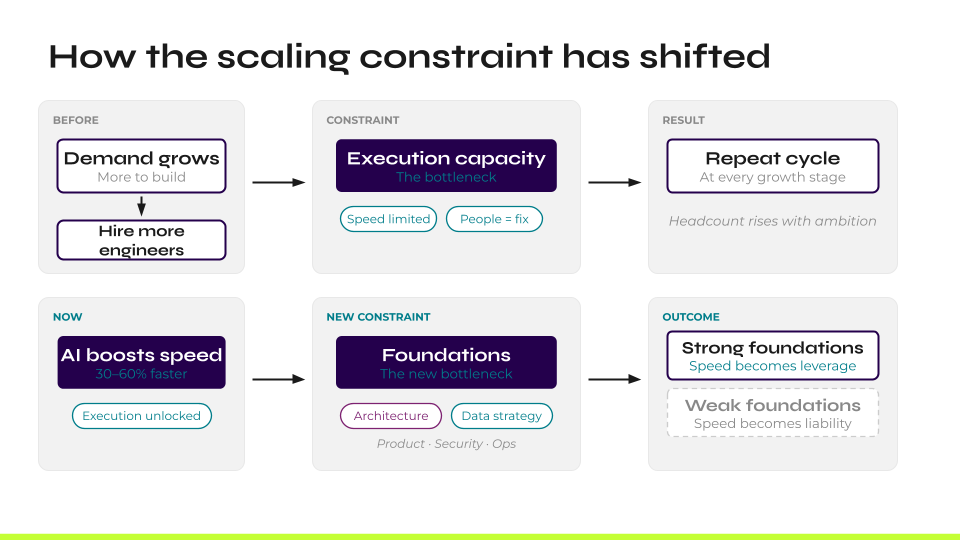
The old rule that more hires equal more growth is starting to crack. For years, scaling followed a predictable rhythm. You hit a delivery bottleneck, you hired engineers. Complexity crept in, you added managers. Headcount rose in step with ambition because execution capacity was the limiting factor. If you couldn’t build fast enough, the solution was obvious. Add people.
AI shifts that logic. Not in theory, but in day-to-day delivery. GitHub’s own research says developers with Copilot completed a coding task about 56% faster than those without it in a controlled experiment. Another study based on trials at Microsoft, Accenture, and an anonymous Fortune 100 company showed a 26% increase in completed tasks for those using AI tools versus those who did not. A figure I’d expect to rise very quickly going forward.
Instead of asking how quickly you can hire, you should be asking whether your foundations can handle the speed you’ve unlocked. That’s a harder question. It’s also the one that determines whether AI becomes leverage or liability.
How AI changes the scaling equation
In the traditional model, startups hit a breaking point at around 50–100 people and the whole organisation had to change. You restructured, added managers, built processes, created reporting lines and hired more developers just to keep pace with demand. The assumption was simple: bigger teams deliver more.
AI empowers engineers to produce more with less. It writes boilerplate, suggests tests, autogenerates compliance content, and even smooths some aspects of internal documentation. That isn’t theoretical. It’s the lived experience of dozens of delivery teams this year.
Pressure points are moving. Execution used to be the constraint. Now the constraint is more often things like architectural clarity, product definition, data strategy and security. The foundations that determine whether speed creates value or just creates mess. In practical terms, the scaling roadmap needs rethinking. Organisations that wait until they hit traditional size thresholds before investing in these foundations will hit a different kind of wall, and they'll hit it faster because they're building more, faster.
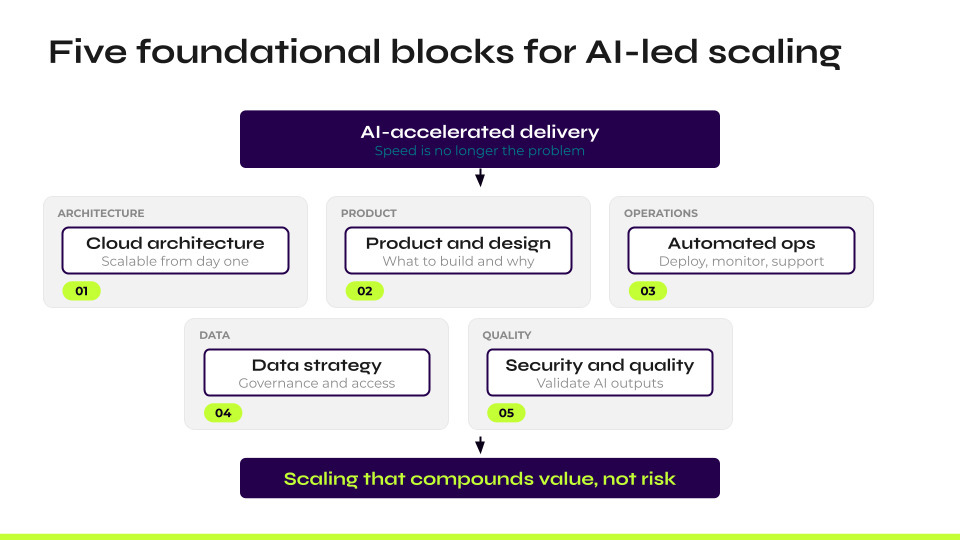
Where should you invest for strong scaling foundations?
1. Cloud architecture and infrastructure
What works for hundreds of users doesn’t reliably work for millions. Even with a small team, you’ll hit performance and cost ceilings if you haven’t thought deeply about scalable systems from the outset. Robust, cost-effective, resilient infrastructure isn’t optional; it’s a prerequisite to accelerate without breaking later.
2. Product management and design
AI can assist with prototyping, but it can’t tell you what to build or why users care. Tools like Firebase Studio, Figma Make and Lovable lower prototyping barriers, but someone still has to define the problem and prioritise the work. That strategic thinking needs to happen earlier and more clearly than in pre-AI scaling models.
3. Automated operations and support
Automation isn’t a nice-to-have. Some startups are now implementing deployment automation, monitoring and even support workflows from day one. But those systems don’t build themselves. You need people who understand operational logic deeply.
4. Data strategy & security
AI runs on data. If your data policies, governance and protection are unclear early on, you compound risk as you scale. Automated code still touches user data. AI-generated workflows still need secure guardrails. And in a growing security environment, every line of machine-produced code can increase risk.
5. Security and quality
As the focus on writing code reduces, the focus on managing its security and quality increases. It's also harder to keep pace. AI introduces non-deterministic outputs, which means traditional testing approaches don't fully apply. The volume of machine-produced code rises, review bottlenecks grow, and subtle vulnerabilities slip through faster. This needs different tooling and different thinking from day one.
What happens when AI increases speed but product strategy is weak?
In the past, execution speed created natural friction. Building the wrong thing took time. That delay forced reflection. Founders saw burn rates climbing before features reached users, which created space to pause and reassess. Slow delivery acted as a crude but effective filter.
AI removes that filter and compresses the time between idea and production.
You can now design, build and ship a feature in days that would previously have taken weeks. It can look polished and pass tests. It can be technically sound. And it can still be the wrong thing to build.
This is why product leadership becomes more important in AI-led growth strategies. Someone has to define what matters, which problems are worth solving and how success is measured. That means tying work back to a clear North Star and measurable outcomes.
We explore this in more detail in our Scale-Up Playbook, where we break down how a defined North Star and focused product strategy prevent teams from drifting as delivery accelerates.
What does capital efficiency mean in AI-led growth?
Capital efficiency is how much progress a company generates for every pound invested. In practice, that means revenue per employee, burn multiple and how quickly product milestones are reached relative to cost.
AI can improve those metrics. Those scaling with AI often delay hiring, ship faster and reach revenue targets with lower payroll. On paper, that makes the business look more efficient.
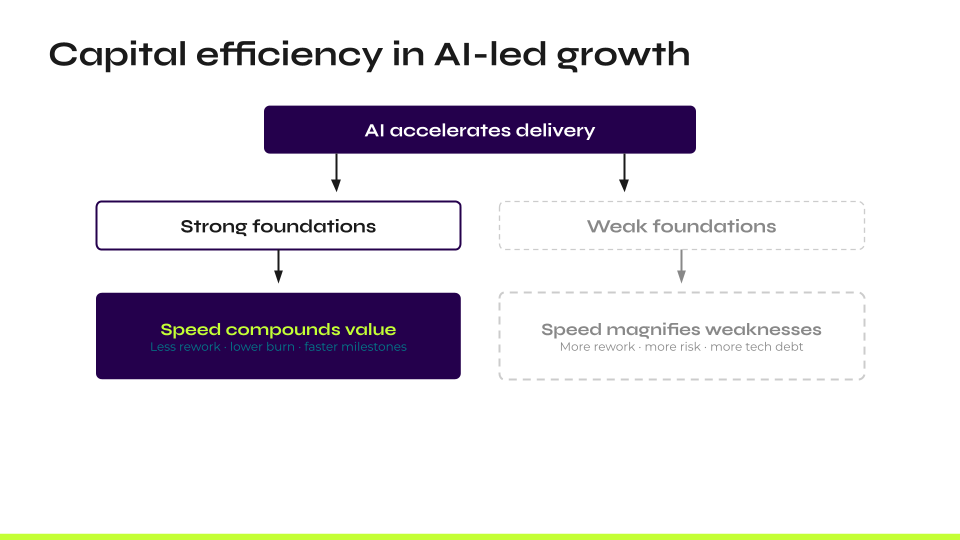
But in AI-led growth strategies, capital efficiency depends on structural quality. If product direction is unclear or architecture is fragile, faster delivery increases rework and risk. Investors are starting to look beyond lean teams. They want evidence of scalable systems and disciplined product strategy, not just reduced headcount.
Capital efficiency improves when foundations are strong. Without them, faster delivery simply magnifies weaknesses.
How to scale with AI without losing structural discipline
Scaling used to mean expanding the engineering team as quickly as demand required. Today it means strengthening the system those engineers operate within. Architectural clarity, product focus and data governance need to be deliberate from the start because AI increases output long before headcount catches up.
You can still grow the team over time. But if hiring is your first instinct every time pressure rises, you’ll lag behind the issues that determine long-term resilience.
Scaling with AI is less about adding capacity and more about increasing coherence.
What this means for your growth strategy
Scaling used to mean hiring fast enough to keep up. Now it means making sure the business underneath can handle the speed you’ve unlocked.
If direction is clear and your foundations are solid, growth feels controlled. If they aren’t, acceleration just exposes the cracks sooner. That’s the difference most teams are wrestling with right now.
The fundamentals haven’t changed. You still need strong product thinking, good architecture and discipline around data. You just need them earlier than you expected.
If you’re looking at your own roadmap and questioning where to focus next, we can help. Take a look at our AI transformation services to see how we turn your ambition into impact.
FAQs
Meet the author
Daniel Llewellyn is Director of Technology at CreateFuture. He specialises in cloud architecture, AI-led delivery and engineering enablement, with a background spanning solutions architecture, security and software engineering across financial services and technology.
.png?width=1080&height=1080&name=Untitled%20design%20(5).png)
Industry Insights
Explore the latest thinking from our industry and tech experts.

AI in UK wealth and pensions: 5 themes reshaping customer experience
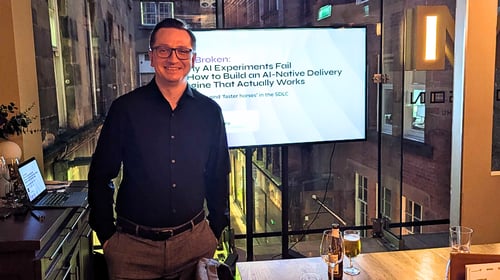
Why do AI experiments fail and how do you scale AI-native delivery?

Empowering Women in Tech: Key Takeaways from CreateFuture's Recent Panel Discussion