
Within CF Next (our dedicated AI team), we set out last year to explore what working AI-native meant in practice — and how it could reshape the way we design, build and deliver software for clients.
At the time, teams across the business were experimenting independently. New tools, workflows, and ways of working were emerging quickly, but the learning was fragmented and there was no shared view of what effective AI-native delivery looked like.
To address that, we began capturing our learnings as we went. We created a shared Confluence space with practical runbooks, video demos, real project examples, and guidance drawn directly from live delivery work. As we developed new skills, tested tools, refined workflows, and evolved delivery practices, other teams started contributing their experiences too.
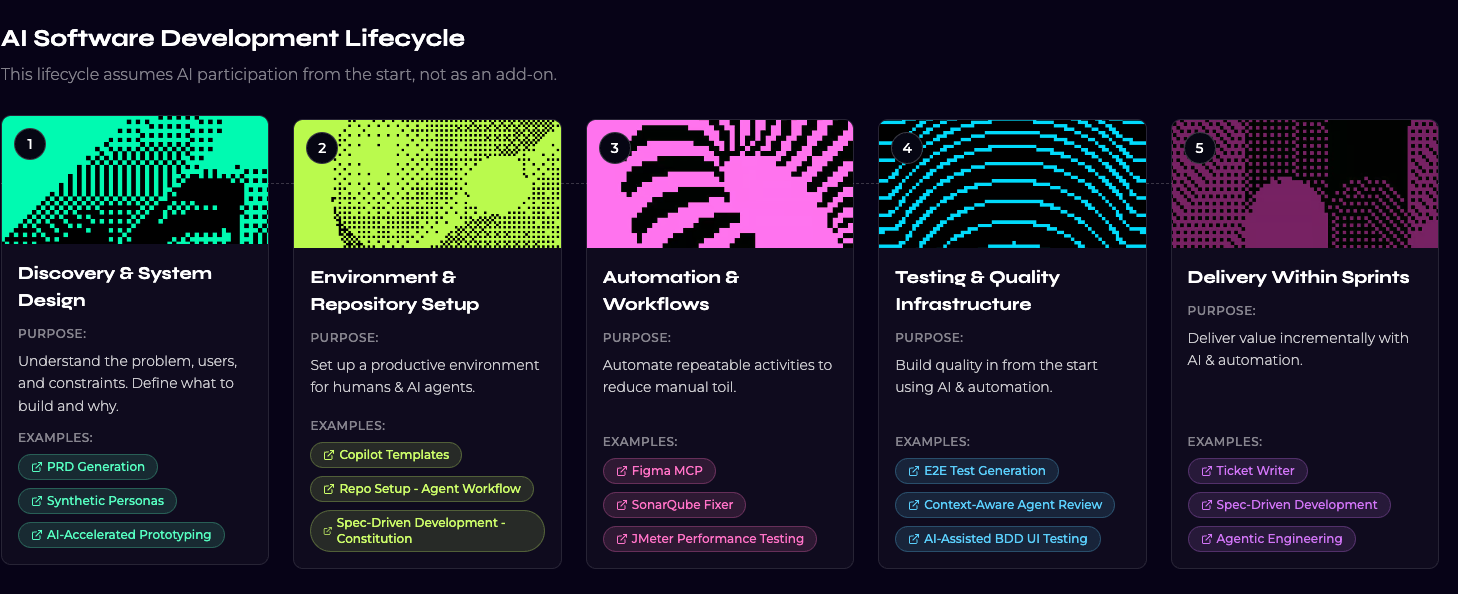
What began as a small internal knowledge base quickly grew into a rich, experience-led collection of insights from people actively doing the work. As it evolved, clear patterns emerged. AI wasn’t just changing individual tasks. It was reshaping the software delivery lifecycle. We saw T-shaped individuals thrive in these new environments, while AI-native teams and ways of working started to become a reality.
That created a bigger opportunity: to take the approaches already proving successful on client projects and make them reusable, scalable, and accessible across the organisation.
To make that possible, we built our AI-native methodology hub - an internal platform that brings together everything we’ve learned so far. It’s a living, evolving space that reflects how we work with AI today, while giving teams the tools, examples, and confidence to build on what others have already discovered.
Turning learnings into something usable
The challenge wasn’t experimentation anymore. It was scaling the learning. We focused on three key areas, capturing proven approaches, structuring knowledge around the SDLC and creating a self-serve platform that could evolve with us.
We applied the same AI-native mindset to building the hub itself. Using tools like Figma Make, we rapidly prototyped the experience and connected it to Confluence through Atlassian’s MCP, allowing content to stay synced and evolve alongside the work itself. Analytics helped us understand how people were engaging and where the platform was creating value.
The result is a living hub that evolves as quickly as the work does - making it easy to surface, share, and scale new ideas, workflows, and use cases over time.
The impact so far
So far, the response has been encouraging. We’ve already seen hundreds of visits since launch, with most people starting at the SDLC overview before diving into the Use Case Library.
What’s been most valuable is seeing how people are using it. Teams aren’t just reading the content — they’re looking for approaches they can apply immediately in their own work.
Even more encouraging is seeing people come back to contribute their own ideas and solutions. Someone solves a problem, realises it could help others, and adds it back into the hub. That’s exactly the culture we wanted to create: people experimenting, learning, sharing, and becoming champions for new ways of working within their teams.
And often, the smallest wins matter most. Every shared insight helps move someone forward from where they were before, and, over time, those small steps compound into meaningful change.
Building with AI-native teams
If you're exploring how AI can reshape the way your teams design and deliver software, we’d love to share what we’ve learned in practice.
FAQs
Meet the author
Milly Henderson is a Product Manager at CreateFuture, where she works across Energy, Financial Services and iGaming clients. She's part of the core team exploring what AI-native delivery looks like in practice, focused on building internal tools and shaping new ways of working across the business.

Industry Insights
Explore the latest thinking from our industry and tech experts.

Can you build an agentic AI architecture for iGaming in one day?

How to scale with AI without over-hiring
Why do AI experiments fail and how do you scale AI-native delivery?